Liability Definition and Types in Accounting with Examples

types of liability

This type of coverage may be bundled as a secondary policy or purchased independently and offers peace of mind in an increasingly litigious society. For example, when a company borrows money from a bank, it creates a financial liability. In another case, if a business buys products on credit, it creates a liability to pay the supplier later.

Types of liabilities based on categorisation

Think of them as the bank loans or notes you’ve signed promising to pay back over time—usually used to buy assets like equipment or vehicles. They’re called “long-term” because, well, they’ll stick around longer than your New Year’s resolutions. Liabilities might not be the most exciting topic, but understanding them is types of liability crucial for any business owner.

types of liability

Non-current Liabilities

Accrued expenses are expenses that you’ve incurred, but not yet paid. Even if you’re not an accounting guru, you’ve likely heard of accounts payable before. Accounts payable, also called payables or AP, is all the money you owe to vendors for things like goods, materials, or supplies. A loan is considered a liability until you pay back the money you borrow to a bank or person.

  • However, contingent liabilities are indicated in the financial statements’ footnotes if the possibility or amount cannot be reliably established.
  • Current liabilities are those that a company must pay within one year.
  • It’s a long-term liability calculated based on factors like employee salaries, years of service, and life expectancy.
  • For most entities, if the note will be due within 12 months, the borrower will classify such note as payable under current liability.
  • For instance, most states require that vehicle owners have liability insurance under their automotive insurance policies to cover injury to other people and property in the event of accidents.

Business Studies

The debt-to-income ratio shows how much of your income goes to paying debts. For example, Annie’s Pottery Palace has $7,000 in debt and $22,000 in assets. Contingent liabilities are types of liabilities that may or may not occur depending on the outcome of a future event. If they are found to be guilty, they would have to pay for damages. A liquidity measure that a company uses to cover short-term loans using cash and cash equivalent is known as the cash ratio. Liabilities are obligations that a company owes financial institutions, expected to be paid at the maturity date.

What is Liability and what are Different Kinds/ Types of Liability

types of liability

Credit card debt often has the highest rates, sometimes above 20%. Lenders check your liabilities to decide if you can repay loans. A https://inforesistencia.com/archivos/130430 high debt-to-income ratio, over 60%, might make them think you are a risky borrower. Deferred revenue is money you get before providing goods or services. It’s a liability because you owe the customer something in return.

  • Not all liabilities are expenses; some, like bank loans, are not day-to-day costs.
  • Our AI-powered Anomaly Management Modulehelps accounting professionals identify and rectify potential ‘Errors and Omissions’ on a daily basis so that precious resources are not wasted during month close.
  • Now that you’ve brushed up on liabilities and how they can be categorized, it’s time to learn about the different types of liabilities in accounting.
  • Any debt a business or organization has qualifies as a liability—these debts are legal obligations the company must pay to third-party creditors.
  • If liabilities are too high compared to assets, or are growing faster than your assets, your business may struggle with solvency and you might need to explore strategies to reduce debt or increase assets.

Understanding Liability: Definition, Types, and Examples

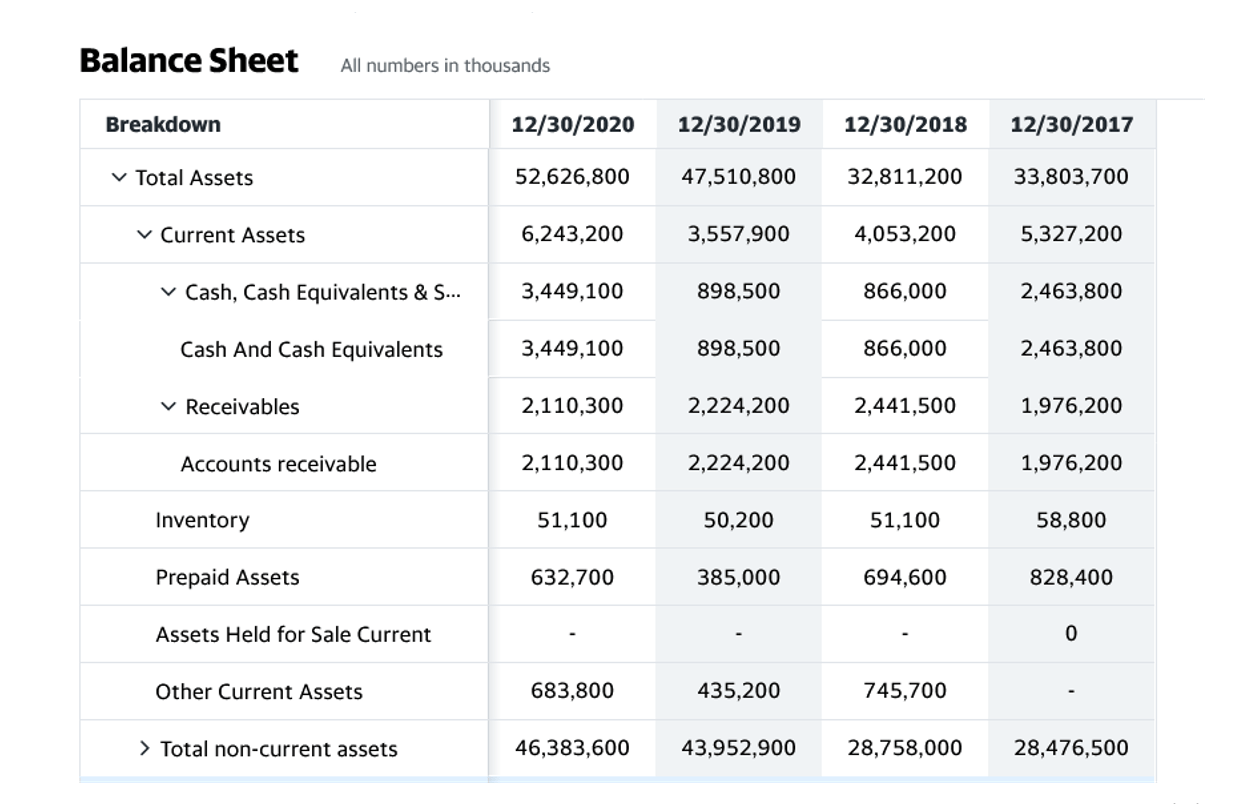
For example, if your pottery shop has $22,000 in total assets What is bookkeeping and $7,000 in debt (liabilities), debts cover 31.8% of your resources. Liabilities like accounts payable or loans directly impact owners’ equity by reducing net worth compared to total assets. Non-current Liabilities – Also termed as fixed liabilities they are long-term obligations and the business is not liable to pay these within 12 months. A liability is a financial obligation a company owes to other parties. These stem from past transactions or events and result in an outflow of resources, usually in the form of money, products, or services. Liabilities are reported on a company’s balance sheet and determine its financial health.

  • Lower balances on these liabilities improve your credit score and free up funds for other uses.
  • For detailed classification, see our page on Classification of Assets and Liabilities and explore sample balance sheet formats on the Balance Sheet page.
  • Liabilities play a crucial role in a firm since they are utilised to fund operations and cover significant expansions.
  • Liability is the money that a business owes a financial institution.
  • Proving your injury occurred is enough to satisfy your burden of proof in some dog bite claims and product liability cases.
  • For example, consider a business that has recently taken out a loan with a 5-year repayment term.

Classification of Liabilities in Balance Sheet

types of liability

Liabilities in accounting are defined as a sacrifice of future economic benefits a company is under obligation to perform as a result of the past transactions with a different entity. There are different types of liabilities that fixed income managers should be familiar with. In particular, we have Type I, Type II, Type III and Type IV liabilities. On this page, we discuss the different types of liabilities that a fixed income fund manager should be able to distinguish.

Private equity: Management Fee: Balancing Management Fees with Private Equity Performance

what are management fees in accounting

These fees can significantly affect net gains, making it essential for stakeholders to understand their structure and implications. Property management bookkeeping requires a systematic approach to online bookkeeping tracking every financial transaction. 80% of property managers collect rent directly so understanding these basics is key to success. Proper trust account management isn’t just good practice; it’s essential for your business and your clients. Property management companies have specific accounting needs, such as property-specific reporting to ensure financial transparency and accuracy. Properly managing accounts payable ensures the company has good supplier relationships and avoids late payment penalties.

what are management fees in accounting

Accrual Based Accounting

what are management fees in accounting

Actively managed funds employ professional managers who seek to outperform the broader market by selecting individual stocks and making strategic trades. In contrast, passively managed funds aim to replicate a benchmark index, such as the S&P 500, by maintaining a portfolio that closely mirrors the index’s composition. Role of Fund SizeOne factor that influences management fees is the size of the investment fund.

Property Management Accounting Processes

However, it enables making an informed decision on choosing a property management plan that optimizes returns. Track property performance over time to evaluate if the arrangement provides the expected ROI. Review each service the management company provides, such as tenant screening, maintenance coordination, legal compliance, etc. Consider if the quality and level of https://www.bookstime.com/articles/independent-contractor-tax-form service justify the fees charged in each area. Regularly reviewing and comparing fee structures among different investment options can help investors identify cost-saving opportunities and choose investments that align with their financial goals.

  • The transparency in fee structures allows investors to make informed decisions, knowing what they are paying for and how it impacts their overall returns.
  • Revenue is recognized over the subscription period, ensuring alignment with ASC 606 or IFRS 15.
  • This fee compensates the managing party for their expertise, oversight, and administrative work.
  • Performance-based fees align the interests of fund managers with those of the investors by tying compensation to the fund’s performance.
  • Performance incentives are a critical component of this alignment, with carried interest and management fees serving as the two primary mechanisms.
  • Management fee structures vary from fund to fund but they’re typically based on a percentage of assets under management (AUM).

Depreciation is the allocation of the cost of a tangible asset, like a building or equipment, over its useful life.

As your portfolio grows accounting processes become more and more critical to profitability and compliance. For example, a December maintenance bill paid in January would be recorded as a December expense, showing true monthly operations. The complexity of your accounting increases dramatically as you move from managing one property to multiple properties. Company ABC hires a consultant to provide recommendations regarding to the new accounting standard. It is not the regular expense that company has to spend to acquire the contestant to provide the best solution. However, the consultant may prepare a contract that does not mention the total invoice bill.

Journal Entry For Management Fees in Hedge Funds

what are management fees in accounting

Hurdle rates and high-water marks are mechanisms designed to protect investors in performance-based what are management fees in accounting fee structures. A hurdle rate is a minimum return that a fund must achieve before performance fees are charged. For example, if a fund has a hurdle rate of 5%, performance fees would only apply to returns above this threshold. High-water marks ensure that investors do not pay performance fees on the same gains more than once. If a fund experiences a loss, the manager must recover the lost value before earning performance fees on new gains.

Importance of Accurate Financial Tracking

Tenant rent payments are typically documented in a rent roll, which provides a comprehensive overview of the monthly rent due and received, as well as any late fees. A classic example of this issue is the hedge fund industry, known for its steep fees. Hedge funds charge a notorious fee structure called “two and twenty,” consisting of a flat 2% of total asset value and 20% of profits earned.

what are management fees in accounting

For example, a property management company might choose a monthly accounting period to track rent collections, maintenance expenses, and other operational costs. Quarterly or annual periods might be used for more in-depth financial analysis and strategic decision-making. Calculating ROI requires homework on the owner’s part to analyze services, costs, and value.

NINJA Loan: Definition, History, Current Availability

This knowledge empowers borrowers to make informed decisions when selecting a lender, ensuring that they align with one whose practices and offerings align with their financial needs. Whenever I tried to get a personal bank loan to buy a car or make some home repairs, the bank gave me a four page application booklet and told me I had to have proof of all income and current debts. I can’t believe these lenders would finance a loan to buy something as big as a house.

NINJA Loans During the 2008 Global Financial Crisis

  • Alternately lenders merely took the word of applicants without verifying their information.
  • While the banking business itself can be complex, the ways banks make money are easy to understand.
  • This means that NINJA loans are no longer common and have been replaced by other options.
  • The financial crisis was primarily caused by deregulation in the financial industry.
  • An acronym for a loan given to a person designated as “No income, no job or assets;” hence – N-I-N-J-A.

NINJA loans played a critical role in the housing market collapse and subsequent financial crisis. As borrowers began defaulting on their obligations, the resulting surge in defaults destabilized mortgage-backed securities, widely held by major financial institutions. The FSA wants to encourage a move towards fee-based investment advice through its retail distribution review , which should be finalised next year. However, mortgage brokers are not included in the RDR, and not all consumers want to pay the fees. An acronym for a loan given to a person designated as “No income, no job or assets;” hence – N-I-N-J-A.

  • Ninja Loans are known for their straightforward approval process, allowing borrowers to navigate the loan application and servicing efficiently.
  • Lenders generally require independent verification of a borrower’s ability to repay a loan by verifying pay stubs, tax returns, and other financial documents.
  • The new requirements for Regulation Z, under the Ability to Repay and Qualified Mortgage Standards ruling, will make ninja loans illegal on January 2014.
  • Lying about income or assets on a loan application is considered financial fraud, even if the lender does not independently verify the provided information.

How to Find Periodic Interest Rate: Smart Strategies

It created immense problems in the credit market and caused the eventual collapse of the global economy during the financial crisis. Conventional loans require the lending institution to do extensive due diligence on a potential borrower to assess their ability to repay the loan. However, it is an intense and lengthy process, so many institutions began to find new ways to “more quickly” offer such loans – one of which was the NINJA loan framework. The rise of financial technology (fintech) companies has introduced new lending models.

Investors seeking quick returns also played a role in the proliferation of NINJA loans. They purchased mortgage-backed securities with high yields, which were often fueled by the riskier loan products like NINJA loans (New York Federal Reserve Bank, 2019). However, this relentless pursuit for ninja loan financial definition of ninja loan profits ultimately led to an unsustainable housing bubble and a wave of defaults that would significantly impact the economy. The widespread availability of NINJA loans contributed significantly to the 2008 financial crisis and the subsequent housing bubble.

Our Review on The Credit One Credit Card

ninja loan financial definition of ninja loan

Ninja Loans lack income verification requirements, relying on stated income provided by the borrower without undergoing thorough verification processes. A Ninja Loan is a high-risk mortgage where the borrower secures financing without providing proof of income, employment status, or assets. From high interest rates to easy approval processes, these loans have a controversial reputation. But how did they get their name, and what role did they play in the financial crisis of 2008? Let’s dive into the world of Ninja Loans to uncover the facts and myths surrounding them.

ninja loan financial definition of ninja loan

NINJA lenders generally offered adjustable-rate mortgages (ARMs) that appeared to offer extremely attractive interest rates for a short period, usually two to three years. After the teaser rate expired, however, interest rates would shoot up, depending on the creditworthiness of the buyer. When mortgage delinquency rates increased in 2007, the value of the underlying asset (the mortgages) decreased. Before it happened, the US Congress passed the 2007 Bankruptcy Bill, which made it possible for insolvent individuals to go bankrupt without recourse. As more individuals found themselves unable to pay their mortgages, they simply stopped paying.

How to Find My Student Loan Account Number: Quick Guide

As a part of new regulation to prevent another subprime housing crisis, this type of mortgage loan will be outlawed soon. The new requirements for Regulation Z, under the Ability to Repay and Qualified Mortgage Standards ruling, will make ninja loans illegal on January 2014. Following the financial crisis, regulators implemented stricter lending standards to prevent similar situations from occurring again.

The Difference Between Fha Loans And Conventional Loans

However, over time, the interest rate on NINJA loans increased to reflect the risk being taken on by the lender. Late payments, missed payments, or other defaults on your account may be reflected in your credit report. Julius Mansa is a CFO consultant, finance and accounting professor, investor, and U.S. Department of State Fulbright research awardee in the field of financial technology.

NINJA loans significantly contributed to the 2008 financial crisis when the housing market bubble burst.4. New regulations put in place after the crisis have largely eliminated NINJA loans from the modern lending landscape.5. It’s crucial for individuals and businesses to practice responsible borrowing practices by providing accurate documentation and maintaining a solid understanding of their ability to repay debts. During the 2008 financial crisis, mortgage lenders issued NINJA loans to borrowers who had no sufficient income or assets.

NINJA loans were a contributing factor to the 2008 Global Financial Crisis – namely, the collapse of the housing market. The US government’s since issued new regulations to improve the standard of lending across the credit market. NINJA loans (no income, no job, no assets) are a category of low/no documentation (low/no doc) loan, also known as “liar loans.”

Oversight is crucial in monitoring compliance with these regulations and identifying any potential risks that could threaten financial stability. Transparency is key in this process, as it helps enhance market confidence and provides investors with a clear picture of the risks involved. Ninja Loans are known for their straightforward approval process, allowing borrowers to navigate the loan application and servicing efficiently.

Candlefocus Financial Terms & Glossary Outstanding Checks What You Need to Know

outstanding checks meaning

Lastly, you can contact the recipient of the check and ask them to confirm whether they have deposited or cashed the check. Learn about outstanding checks in accounting and how they impact your finances. Gain insight into managing and reconciling your financial transactions effectively. Communication with PayeesRemember to maintain contact with payees and remind them about any outstanding checks. If they haven’t received payment, this may encourage them to deposit or cash the check. In some cases, they might notify you to reissue the check if it has been lost or misplaced.

Factors Leading to a Check Remaining Outstanding

Accountants must regularly compare the check register against the bank statement to spot discrepancies. This practice, known as bank reconciliation, is typically performed at the end of each accounting period. The bank reconciliation process aligns the bank statement with a company’s accounting records to maintain accurate Bookkeeping for Consultants financial records. Outstanding checks pose challenges to this alignment because they represent transactions recorded in the books but not yet reflected in the bank statement. Addressing these discrepancies is essential to ensure accurate financial statements.

Potential for Overdrafts and Insufficient Funds

Monitor Your Account RegularlyRegularly monitor your account balance to ensure sufficient funds are available for outstanding checks. By keeping track of your finances, you can avoid accidentally overspending and incurring unnecessary fees or charges. Remember, it’s essential not only to be aware of the funds available but also to recognize which checks have cleared and which are still outstanding. Switch to Electronic Payment MethodsAs banking continues to evolve toward more electronic transactions, consider using online bill pay services.

Avoiding Outstanding Check Issues

When a customer deposits outstanding checks a check in his account, the bank immediately credits his account with the amount of the check deposited. Sometime such checks are not honored because the person issuing the check does not have sufficient funds in his account. In such situation, bank reverses the entry and reduces the balance of depositor’s account to previous amount.

outstanding checks meaning

The payor must be sure to keep enough money in the account to cover the amount of the outstanding check until it is cashed, which could take weeks or sometimes even months. You issued a check to Mr. X (one of your creditors) for $500 on January 31, 2021 and entered it immediately in your accounting records. Mr. X did not present or deposit that check in his account before the end of January. Your bank statement for the month of January would not show the entry for that $500 because Mr. X did not present this check before the end of January. It would essentially create a difference of $500 between the balance in your accounting records and the balance in the bank statement.

outstanding checks meaning

  • After resolving discrepancies, financial records are updated to reflect adjustments.
  • On the payee side, outstanding checks create a risk of expiring or becoming “stale.” When this happens, the check can’t be cashed or deposited, and the payment must be reissued or made another way.
  • This has supported efficient money transfers while saving on cost and time taken with paper check cutting services.
  • The receiving bank often stamps the back with a deposit stamp at the time it is deposited or cashed, after which it goes for clearing.
  • Lastly, you can contact the recipient of the check and ask them to confirm whether they have deposited or cashed the check.

The payee should contact the issuer to request a new check if this occurs. The bank statement of the Fast Company shows a balance of $10,000 on January 31, 2021 whereas the company’s ledger shows a balance of $8,525. This process is part of the accounting cycle, allowing the company to accurately report cash, a current asset, on its balance sheet. An unpresented cheque is a check that a company has written, but the check has not yet been paid by the bank on which it is drawn. An unpresented check is also referred to as an outstanding check or a check that has not yet cleared the bank. It’s crucial for businesses to promptly communicate with payees about issued checks, especially considering potential postal delays.

outstanding checks meaning

It’s possible that the bank could also decline to honor the outstanding check, as well. Bouncing an outstanding check can lead to financial consequences, such as fees imposed by the bank, damage to your credit rating, and potential legal actions from the payee. Be mindful of what outstanding checks you’ve written before drawing down your bank balance.

Risks of Outstanding Checks

outstanding checks meaning

This typically includes sending written notices unearned revenue to the payee’s last known address within a specified time frame prior to escheatment. Unclaimed checks fall under the “escheatment process,” where you identify, report, and remit unclaimed property if it lies dormant for too long. An outstanding check example could be a rent check you mailed to your landlord, but they have not deposited it yet.

3 Best Accounting Firms in San Jose, CA Expert Recommendations

bookkeeping firms San Jose

They strive to help small businesses with bookkeeping services, payroll, accounts payable and receivable services, budget and forecasting, and more. Our services encompass nearly every aspect of financial life. We areexperienced in all matters of accounting and taxation, IRS problem resolution, estates and trusts, business formation,financial planning and investment, real estate and business sales. My firm uses professional tax software and state of the art on-line research tools. These tools, along with my education and experience, allow me to offer you the superior professional services you expect, at a fair and equitable price, and on a timely basis.

ACTIVATED GROWTH STRATEGY

  • Our team tracks payment due dates, sends polite reminders for overdue payments, and reconciles payments received.
  • The company understands that well-organized and business-relevant bookkeeping will facilitate a CPA’s work, enhance the client’s profit, limit growing pains, and lighten the burden of a potential audit.
  • 37% (10 clients, $4,089/Yr. Avg.); Consulting/Misc.
  • But there’s another reason we’re No. 1—because we are the best bookkeepers in San Jose.
  • At Acuity, we specialize in personalized accounting solutions for entrepreneurs.

Now that we’ve broken down the key differences between tax accountants, tax preparers, and outsourced accountants, let’s get into the main event. Here’s what we think it takes to make the top-10 list of high-caliber adjusting entries Certified Public Accountants and Tax Accountants for small businesses in San Jose. Whether you need to unravel a complex challenge, launch a new initiative, or want to take your business to the next level, we’re here. Share your vision and we can help you achieve it.

Our Services

  • You can be confident that our practice listings are solid.
  • 42% Net, but practice software is provided for franchises.
  • We don’t just crunch numbers; we interpret them to help you make informed decisions for your company’s growth.Our commitment to excellence extends to our customer service.
  • The company provides a specific range of services meant to fit a client’s needs.
  • Tax preparers focus on preparing your small business’s tax returns, ensuring your returns are accurate, and helping you file them on time.
  • Ranking fourth on our list of the top small business accounting firms is SJ Accounting Consulting, Inc.

Additionally, it has estate planning and investment management services. The firm is headed by Mahbub Alam, a certified public accountant who is proficient in Quick Books Pro, Excel, and Solomon III and IV. George Dimov, CPA, has been providing accounting services to personal and commercial clients in San Jose for over 12 years. For individuals, he and his team assist with common taxation concerns, such as income, property sale, cryptocurrency, and equity compensation.

  • Don’t settle for a year-end or reactive tax accountant, we’ll help throughout the year to lower your taxes.
  • Your dedicated account manager will work closely with you to understand your business and tailor our services to your specific needs.
  • And we’re always looking for great talent.
  • ASL believes that contributing to the financial well-being of its clients allows for a mutual opportunity for growth.
  • As one of the top CPA firms in San Jose, it offers a holistic suite of guiding services which support the development and management of your financial objectives.

#2 Bookkeeping Services Near San Jose

bookkeeping firms San Jose

LMGW has a broad client base which is composed of everyone from individuals to nonprofit organizations. Additionally, the firm has been rated as one of the Best Accounting Firms to Work for by Accounting Today in 2009, 2010, 2011, 2012, and 2014. LMGW Certified Public Accountants, LLP has been serving the greater San Jose for nearly 40 years by offering highly customized solutions and building meaningful relationships. It works with other organizations to develop and implement tax strategies that allow you to minimize your burden while maintaining the health of your finances.

bookkeeping firms San Jose

#7 Bookkeeping Services Near San Jose

bookkeeping firms San Jose

The biggest confusion you might have is between a tax accountant and a tax preparer. While both focus solely on taxes, there is a huge difference – tax preparers are not CPAs. They don’t need advanced accounting degrees or a license. However, they do need to complete registration requirements with the State of California. When looking for tax and accounting help for your small business, we know you are bombarded with ads and options.

Each is designed to help people just like yourself  to better understand a variety of financial subjects so that you can take charge and make educated decisions. With the ever-increasing presence of technology, it is crucial for San Jose CPA firms to stay up-to-date with the latest technological advances. Founded in 2010, Altum Partners, LLP is a Certified Public Accountant Firm serving the needs of How to Invoice as a Freelancer both individuals and corporate entities through 2 separate San Jose offices.

Altum Partner’s Tax Services Team works with clients to help them reach various economic goals. A focus remains on bookkeeping san jose modeling partnership agreements for tax consequences, allowing appropriate distribution and allocation following an economic deal. While both offices are located inside the same building, one office focuses on Individual/Flow-Through services, while the other specializes in Corporate services.

#1 Bookkeeping Services Near San Jose

  • NSKT Global serves small businesses and large enterprises in San Jose.
  • Seller is open to a separate sale of the tax clients.
  • Our firm’s reputation for providing quality service reflectsthe high standards we demand of ourselves.
  • We offer a broad range of services to help our clients.
  • Our Catch-Up service is designed to bring your financial records up to speed quickly and efficiently.

Adhering to the budget is critical during an economic downturn. Our team of accounting and bookkeeping professionals has data available quickly to offer strategic financial insights which may be critical for business success. Working with clients around the world and serving both Indian and U.S. clientele, Sanjiv Gupta CPA is a Fremont-based Certified Public Accountant firm that is accredited by the Better Busines Bureau. Ranking fourth on our list of the top small business accounting firms is SJ Accounting Consulting, Inc. Sung Lee is both a certified public accountant and a certified financial planner to offer you complete financial services. SJ Accounting Consulting, Inc. can act as a CFO for your business, while also handling your day-to-day needs.

Advertising Costs: Definition and How It Works in Marketing

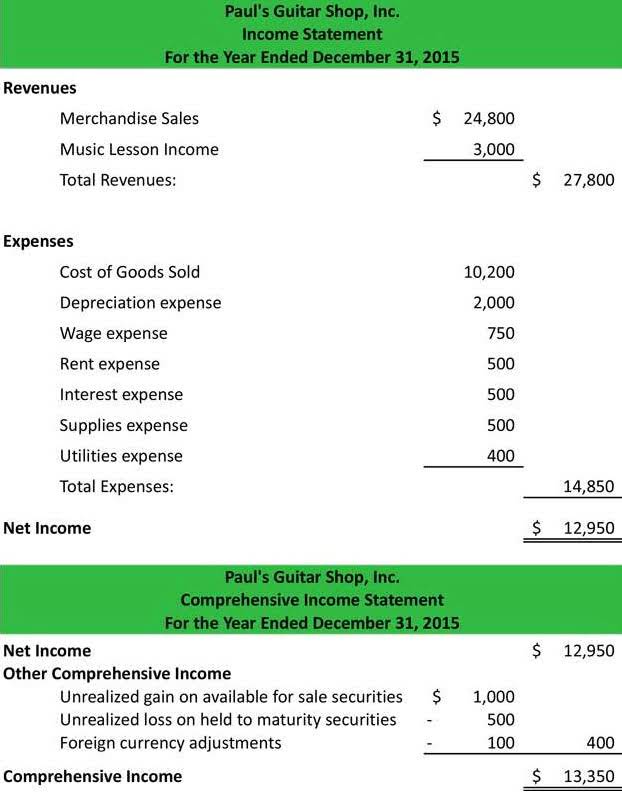
It should be known that advertising expenses on an income statement are generally grouped into SG&A expenditures. For every business year, each company drafts its annual budget assigning the money to spend in different fields. The items included in an annual budget serve as another example because budget allocations typically don’t change until the next planning cycle. Advertising is considered an expense item; part of operating expenses recorded on the income statement. Traditional marketing relied on fixed budgets, but digital marketing is more flexible and performance-driven.

  • This approach provides more stability and helps your company to maintain its market share during economic downturns.
  • The fixed marketing costs include sales force expenses, advertising campaigns, sales promotion and distribution costs.
  • In this article, we’ll break down how advertising costs work, providing real-world examples from both traditional and digital advertising sectors.
  • A common question that arises is whether advertising costs are fixed or variable.

The Ultimate Guide to Increasing Brand Awareness in 2025: 15 Proven Strategies

You can use metrics such as website traffic, click-through rates, conversion rates, and customer engagement to assess the effectiveness of your marketing efforts. By analyzing these metrics regularly, you can make adjustments to your marketing strategy and maximize the ROI of your fixed marketing expenses. A fixed expense is one that does not change based on production levels or sales volume fluctuations. When you allocate a marketing budget, it is usually fixed over the coming year since it doesn’t change.

How to Securely Pay Your Electricity Bill Online – Best Practices

The budget will depend on how many times a form wants to run its advertisements. To adhere to this question, let’s know about what is the difference between these business costs. Balancing both types of costs ensures steady brand growth and scalable results. In 2022, your company still invests $500,000 because that’s 10% of the prior year’s revenue.

Don’t Fall In The Trap of Marketing as a Variable Expense

Therefore, in most straightforward instances, fixed costsare not relevant for productiondecision, and incremental costs, or variable costs, are relevant for these decisions. To better understand how fixed and variable costs differ, let’s use personal finances as an example. Fixed costs are expenses that remain constant regardless of the level of production or sales.

As total fixed costs are those which are spent in fixed quantity over a particular period, average fixed costs are the total fixed cost per unit of output produced. For example, if the output increases, the average fixed cost will decrease as now less fixed expense is divided because of the new unit sold. When accounting for advertising expenses, these costs are typically classified as sales, general, and administrative (SG&A) expenses on a company’s income statement. However, whether advertising costs are classified as fixed or variable depends on the specific circumstances and strategies of the company. To calculate the proportion of fixed vs. variable advertising costs, businesses can use basic accounting tools like cost allocation models or budgeting software.

In most cases, advertising costs are considered variable expenses that fluctuate based on the level of advertising undertaken. This means that a specific amount of money is allocated for advertising expenses throughout the calendar year. The budget is then divided among various advertising formats, such as print, online, or radio ads. While this approach may not allow for significant growth in advertising efforts, it provides smaller companies with a predictable and manageable advertising expense. Social media advertising costs include ad spend (paid to social media networks) and ad management (paid to a third party for services).

  • Not only that but when there are seasonal variations, the market demand and supply change.
  • Additional materials, such as the best quotations, synonyms and word definitions to make your writing easier are also offered here.
  • Regardless of whether advertising is classified as fixed or variable, effective cost management is essential.
  • I’m not sure if there is a rule of thumb in knowing the difference, and your criticism is probably valid in a sense.
  • Indirect costs are the indirect costs incurred during the manufacturing process and are unrelated to the production process.

How to Implement a Fixed Marketing Expense Model

Therefore, as advertising is considered a part of marketing strategy, companies tend to fix either a separate budget for advertising or a certain section in their fixed marketing budget. One example of a variable advertising cost is pay-per-click (PPC) online advertising, where companies pay for each click their ads receive. Additionally, the cost of running a radio or TV advertisement is typically based on the frequency of broadcasts or the duration of airtime purchased.

is advertising a variable expense

Any cost that changes based on production or sales volume is considered a variable cost, which includes things like the cost of producing a product, advertising costs, and shipping costs. While businesses have a fixed budget for marketing, they can allocate a certain budget for advertising within that fixed marketing budget. It’s essential to know what these costs are, and to budget strategically so that they are manageable – no matter what the future holds. Covering fixed costs is a necessary fundamental in order to keep your business alive. In marketing, it is necessary to know how costs divide between variable and fixed costs. This distinction is crucial in forecasting the earnings generated by various changes in unit sales and thus the financial impact of proposed marketing campaigns.

Adding both the costs, that is, total fixed cost and total variable cost, we get the total costs incurred by the business owner. Fixed expenses or costs are those that do not fluctuate with changes in production level or sales volume. They include such expenses as rent, insurance, dues and subscriptions, equipment leases, payments on loans, depreciation, management salaries, and advertising. In accounting terms, marketing expenses are defined as expenses that directly relate to the selling of a product, service or brand. Your marketing spending categories might include printed publicity materials, newspaper advertising, the marketing team’s salaries and the cost of Facebook ads. In the fixed cost model, the company invests the same amount of money in marketing every year, regardless of changes in market forces.

Why Categorizing Expenses Matters

For example, a business owner has to pay a fixed rent to the landowner, say, annually for using the land even if the production is low. Insurance, interest payments, wages, and salaries are some other examples of fixed costs. As the 6th most used social platform globally, TikTok presents an excellent opportunity for your business to reach more people. To get your business in front of more TikTok users, you’ll want to invest in TikTok advertising — which means you need to know the TikTok advertising costs. Advertising costs are often deemed to be expensed as soon as they are incurred by some accountants. According to is advertising a variable expense those who support using expenses as incurred, advertising expenditures may lead to uncertain future benefits.

However, what remains constant is the need for efficient advertising cost management. GLMA Agency stands ready to help businesses navigate this critical financial aspect for maximum success. If, say, the revenue generated is less for a given month, the company will cut down on its variable costs for the next month. These cost changes can vary from high to low based on the production level.

By tracking monthly expenses and categorizing them, companies can get a clear picture of how much of their advertising spend is predictable versus performance-dependent. The term “fixed” means having a predetermined value that doesn’t change over some time. Similarly, fixed costs are those which are incurred by a company over a specific duration and are not subject to change regardless of the level of output.

What Are Investing Activities? How to Report Investment Activities on the Cash Flow Statement

investing activities cash flow

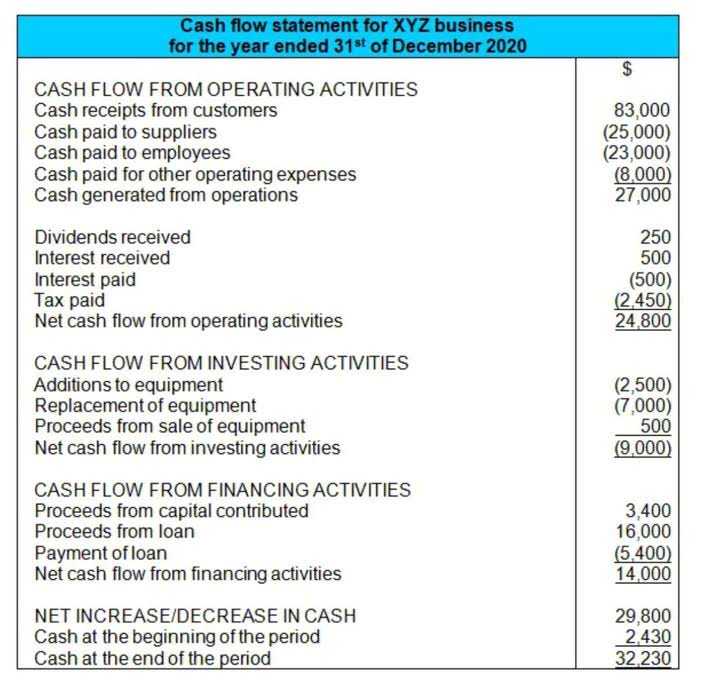
Investing activities include purchases of physical unearned revenue assets, investments in securities, or the sale of securities or assets. Investment may generate income or ensure the long-term health or performance of the company. If the starting point profit is above interest and tax in the income statement, then interest and tax cash flows will need to be deducted if they are to be treated as operating cash flows.

  • Cash flows from investing activities is a critical concept within financial accounting and analysis.
  • Moreover, financing cash flow reveals how a company raises and repays capital, with excessive debt issuance posing risks but steady dividend payments suggesting financial stability.
  • Out of the three, cash flow from investment activities—or cash flow investment—provides valuable information about a business’s long-term health and growth potential.
  • This is the final piece of the puzzle when linking the three financial statements.
  • Understanding cash flow formulas is crucial for any business owner or finance professional.

Revenue Reconciliation

As mentioned previously, you may also spend cash on purchases of marketable securities, such as stocks in other companies, which can earn you dividends and be easily converted to cash. Cash flow statement investing activities is the second section of the statement, and it’s an integral part. Here’s why; investors usually go to this section to track changes in the Capital Expenditures. Some companies will have items not mentioned above, so it’s important to look at the balance sheet of a company to determine the line items. Your business can be profitable without being cash flow-positive, and you can have positive cash flow without actually making a profit. Whenever you review any financial statement, you should consider it from a business perspective.

investing activities cash flow

Challenges in Evaluating Cash Flows from Investing Activities

investing activities cash flow

An item on the cash flow statement belongs in the investing activities section if it is the result of any gains (or losses) from investments in financial markets and operating subsidiaries. An investing activity also refers to cash spent on investments in capital https://www.bookstime.com/ assets such as property, plant, and equipment, which is collectively referred to as capital expenditure (CapEx). Cash flow from investing activities includes any inflows or outflows of cash from a company’s long-term investments.

  • If you invest in an asset for over a year with the expectation of long-term growth and profitability, it’s a long-term investment.
  • Another aspect to note about Vincent’s example is how he liquidated his 25% stake (£100k) in order to reallocate funds into the CapEx purchases of factory and equipment.
  • This figure provides insight into how a company is allocating capital to support its future growth or divestitures.
  • This real-time understanding can ensure the allocation of resources remains aligned with the company’s evolving needs.
  • Sometimes it may sell restaurant equipment that is outdated or unused, which then brings in cash instead of being an outflow like other CapEx.

HighRadius Named a Challenger In 2025 Gartner® Magic Quadrant™ for Financial Close and Consolidation Solutions

  • You generally read a statement of cash flows from top to bottom, adding or subtracting for each line item to arrive at a total inflow or outflow for each of the categories of cash flows.
  • In a nutshell, we can say that cash flow from investing activities reports the purchase and sale of long-term investments, property, plants, and equipment.
  • Positive investing cash flow might mean companies selling assets, which could signal downsizing or generating cash for other needs.
  • High capex can indicate expansion, but excessive spending without strong operating cash flow may strain liquidity.
  • However, we add this back into the cash flow statement to adjust net income because these are non-cash expenses.

Reinvestment means using the income from an investment and buying more of the same/different investments. To build a cash-flow-driven investment portfolio, consider cash flow needs, return expectations, risk preferences, and diversification benefits. In this hypothetical situation, we will look at the investing activities of Company X. DCF analysis helps you determine if an investment is worthwhile by comparing the present value of future benefits to the initial cost. In particular, Capex is typically the largest cash outflow — in addition to being a core, recurring expenditure to the business model.

investing activities cash flow

  • For example, after investing heavily, net cash flow may show as negative, which may ring alarm bells.
  • Cash flows from investing activities serve as a vital component of a company’s financial health and overall strategy.
  • This helps in getting the whole picture and also helps to take a much more calculated investment decision.
  • The company also strategically bought franchises and spent $4.3 million in 2012 doing so.
  • In its 10-K filing with the Securities and Exchange Commission (SEC), the company details that it spends money to remodel existing stores and build new ones, as well as to acquire the land to build on.

The company’s policy is to what are investing activities report noncash investing andfinancing activities in a separate statement, after thepresentation of the statement of cash flows. This noncash investingand financing transaction was inadvertently included in both thefinancing section as a source of cash, and the investing section asa use of cash. The direct method presents actual cash receipts and payments from operating activities. Instead of starting with net income, it lists cash inflows and outflows to core business operations. Alternatively, the indirect method starts with net income from the income statement and adjusts it for non-cash items and changes in working capital to arrive at cash flow from operations. Knowing how the cash flow statement relates to other financial statements is important.

investing activities cash flow

The issuance of debt is a cash inflow, because a company finds investors willing to act as lenders. However, when these debt investors are paid back, then the repayment is a cash outflow. The interest and dividend received by a company are treated as cash inflow from investing activities. The users of a cash flow statement of a company can evaluate the impact of the activities mentioned above on its cash and cash equivalents. You could search online for cash flow statement examples from companies you might invest in. They are generally available on a company’s investor relations website and through the website of the US Securities and Exchange Commission.

Understanding Conversion Costs: Definition, Formula, and Examples

examples of conversion costs

When you understand the difference between prime cost and conversion cost, you can easily calculate the prices conversion costs of your finished goods. Direct material cost encompasses the expenses related to raw materials used in production. Examples include steel in construction, plastic in injection molding, or flour in baking. Misclassifying these costs can severely distort a company’s financial health. For instance, wrongly allocating an overhead expense to prime cost would lead to an incorrect calculation of the Cost of Goods Sold (COGS) and an inaccurate valuation of closing inventory. This, in turn, distorts the reported gross profit and net profit, leading to flawed business analysis and poor decision-making.

Native Ads Examples

examples of conversion costs

With the rise of smart speakers and voice-enabled devices, more people are speaking their queries instead of typing them. What is A/B Testing Have you ever wondered how some websites seem to know exactly what their visitors want? YouTube bookkeeping Growth Agency YouTube has transformed how brands connect with audiences. However, navigating this platform can be challenging without expertise. SEM Headline Crafting the perfect SEM headline is more than just a few well-placed words.

examples of conversion costs

Ad Headline Google Ads

Suppose a manufacturing company budgeted $100,000 for conversion costs for a particular production run. This would result in a positive conversion cost variance of $10,000. Conversion Cost Variance is a metric used to assess the variance between the actual conversion costs incurred and the budgeted conversion costs. It provides insights into the efficiency and effectiveness of the production process. By analyzing this variance, companies can identify areas of improvement and take corrective actions. Direct material costs encompass the expenses related to raw materials directly used in production.

examples of conversion costs

How we can choose the Right Law Firm SEO Company

Of course, that is not always possible, such as in the case of shorter advertising campaigns. Textbook content produced by OpenStax is licensed under a Creative Commons Attribution-NonCommercial-ShareAlike License . Direct labor costs are the same as those used in prime cost calculations.

SEO in Nebraska

examples of conversion costs

Calculating manufacturing overhead can be complex, as it involves allocating costs across various production activities. All indirect manufacturing costs, including factory rent, utilities, equipment depreciation, and indirect labour (like a supervisor’s salary), are classified as manufacturing overhead. Budgeting for Nonprofits Therefore, these costs are a key component of conversion cost but are completely excluded from prime cost, which only includes direct costs. No, these concepts are primarily used in manufacturing industries where tangible raw materials are transformed into physical products. Service industries do not have direct material costs in the same way. Instead, they use different costing models that focus on the cost of services rendered, where labour and overheads are the primary components, but the prime/conversion distinction is not relevant.

examples of conversion costs

Touch Screen Cash Register,restaurant Cash Registers,retail POS Systems

There are multiple types of cash registers, including electronic registers, Square iPad cash registers, and other computer-based registers. While each register has some unique features, they all share similarities in their operation. Depending on your point-of-sale software provider, the number of products you can add may be limited. But with Shopify POS, you can add as many products as you need. You can also categorize them by collection, set inventory status, manage omnichannel inventory, create barcodes, and more.

Step 3: Add a discount or gift card coupon code

This is going to include a cash drawer, credit card reader and a receipt printer at least. No one can deny that touch screen cash register systems are amazing. They are efficient, user-friendly, and they are designed in such a way that they provide better customer service. As a business owner, you will realize that other cash register systems will not be able to give you the customer service you need.

how to use a touch screen cash register

The easiest way is by scanning the barcode or UPC with a barcode scanner. If you don’t have one, look for the item with the on-screen buttons or search for it using the on-screen keyboard. If you decided to buy a modernPOS system that runs on an iPad, then the setup process should be pretty straightforward. You’ll want to connect your device to power, turn it on, and download your system’s register app from the App Store.

You don’t even need additional hardware like a barcode scanner (unless you prefer it). When the software side of your system is ready to go, and your tablet register is working, the next thing you’ll want to do is set up your hardware peripherals. For most businesses, this is going to include a cash drawer, credit card reader and a receipt printer at a minimum. If you run a retail business, you might also have a barcode scanner. Unlike their predecessors, touch screen cash registers (when integrated with POS software) can do so much more than simply calculate payments and store cash. Touch screen POS systems can now manage your entire business from one, centralised system – from payments to orders, inventory and reporting.

Accept a check transaction

  • Time to head home for some much-deserved rest and relaxation.
  • You can give each staff member a unique PIN to log in to the POS system.
  • You will, therefore, be able to deliver the right pizza or burger with the right toppings.
  • All the information related to the sales and inventory will be stored in the cloud.
  • The touch screen cash register is like the iPhone – the physical thing that you can touch, and the point of sale system is like iOS – the software that powers the device.
  • A cash register is a machine that helps businesses handle sales.

In today’s modern retail environment, cash registers have evolved from traditional mechanical devices to advanced touch screen systems. Mastering the art of using a touch screen cash register is crucial for retail business owners and their employees. To help you get acquainted with this technology, we have put together a step-by-step guide to walk you through the process.

Accept a cash transaction

They tend to be more efficient and effective than the technologies they’ve replaced. Besides reducing customer waits to check out, the data they generate improves the management of stock levels and automates restocking items. One of the primary functions of a cash register is to track and manage your inventory. To add products, navigate to the inventory management section and find the option to create a new item.

Double-Check Large Bills

  • If your store uses product lookup (PLU) codes (common in grocery stores and markets), take the time to memorize the ones you use most.
  • These devices connect to your device with either a cord or wirelessly over Bluetooth.
  • They’ll synchronize the information of goods to avoid errors in data entry and calculation for accurate data.
  • Using POS software for the first time or switching to a new POS system can feel impossible.
  • Considering the advantages, a touchscreen cash register for a restaurant seems like the right option.

The first step is to enter ‘new sale’ and then add the item that the customer is buying into the register. Running POS software on a touch screen device is user-friendly and intuitive. You and your staff are likely already very comfortable using an iPad or tablet, so there’s not a huge learning curve. You can cut down on staff training time and start selling right away.

Once you have identified the hardware components, it’s time to power up the cash register. Each system may have a unique login process, so follow the instructions provided by the manufacturer or your IT department to log in. There is going to be a “Cash,” “Credit/Debit,” and even “Check” button for this.

Your store design should match your branding and a touch screen cash register is a great way to create a modern feel. Touchscreen cash register systems can be customized to suit your business needs. This means that you have the liberty of choosing specific features that will make it suitable for your business. These features include the receipt printer, the cash drawer, and the functionality. The functionality includes other functions that you may need at your restaurant, such as loyalty cards. In the items of your retail store, there will be taxable or non-taxable items.

how to use a touch screen cash register

Step 5: Turn on the cash register

It’s where you process payments, print receipts, and safely store cash during your shift. But beyond that, it also helps keep track of sales and revenue. Before you start accepting customer payments in your store, it’s important to make sure your touch screen cash register and POS system are integrated and working correctly.

In modern POS systems, this application is accessed with a web browser on a laptop or desktop computer. Which in turn, lays the foundation for your business’ growth. With your system set up and your doors open, the next thing you’ll likely do is run a live transaction. You may how to use a touch screen cash register want to go for a larger screen that makes it easier to work on, but this won’t be the best option for a smaller restaurant.

Contra Revenue: What It Is and How It Impacts Your Financial Reports

These items represent reductions in the initial sale price, reflecting situations where a customer didn’t pay the full original amount. If Company A offers a two percent discount on the total amount if paid within a week instead of the usual 30 days, the company records the discounted amount in its contra account as Sales Discounts. The company would see the original amount, discounted sale, and net sales in the contra revenue account. The company estimates that it will not be able to collect 1,000 from its customers. The allowance for doubtful accounts is a contra asset account that is used to offset Accounts Receivable on the balance sheet. A contra asset account is an asset account where the account balance is a credit balance.

  • Understanding these categories is essential for accurate financial analysis.
  • A contra revenue account is a general ledger account that records deductions from a company’s gross revenue to arrive at net revenue.
  • Accurate contra revenue accounting, therefore, isn’t just about following rules; it’s about maintaining the integrity and credibility of financial reporting.
  • If the customer takes advantage of the early payment discount, Code Wizards receives $980 ($1,000 – $20 discount).
  • Discounts are a common sales tactic, and correct accounting helps in performance evaluation.

Sales Discounts

Since each of these deductions directly reduces your profits, it makes sense to research them in detail, to see if there are any actions that can be taken to reduce the number of deductions. For example, this analysis might indicate that your business has product quality problems or servicing issues that can be corrected. In addition, you can examine the impact of sales discounts on increases in sales, to see if it makes sense to continue offering discounts in order to boost profits. The sales returns contra sales account records the sales value of goods returned by a customer. The account is normally a debit balance and in use is offset against the sales account which is normally a credit balance.

Revenue vs. income: Why you need to know the difference

However, the story behind the top-line revenue figure is often more complex than it appears. Deferrals involve delaying the recognition of certain revenues or expenses until they are earned or used. Unlike accruals that record transactions that have occurred but aren’t yet documented, deferrals handle transactions that have been documented but haven’t yet occurred from an accounting perspective. At Zeni, we keep it simple for you to record all of your contra revenue in one dedicated place and view the changes to your accounts over time AND in real-time. Our AI-powered tool gives you daily access to your company’s finances while our expert finance team double-checks the numbers every step of the way.

Sales Returns: The Case of Defective Electronics

  • Net revenue, on the other hand, offers a more accurate representation of a company’s actual earnings.
  • Common examples include sales discounts, sales returns, and allowances.
  • It’s crucial to have an accounting and bookkeeping team (whether outsourced or internal bookkeeping) to help ensure accuracy for your contra account.
  • Contra revenue analysis helps drive informed decision-making, leading to improved profitability, customer relationships, and overall financial performance.
  • Tech Solutions initially recorded $50,000 in gross revenue (100 units x $500).

They’re typically recorded as the same type of account as their parent but carry a negative balance. Keep reading to learn more about contra revenue accounts and what should go in them. However, some transactions may also decrease them while not directly stated on the income statement. The company would then have a contra liability account for the bonds. This would allow the company to track the amount of money that contra revenue meaning has been borrowed.

How does contra revenue affect a company’s financial statements?

While GAAP doesn’t explicitly dedicate an entire section to “contra revenue,” the principles are embedded within the revenue recognition standards. Specifically, ASC 606, “Revenue from Contracts with Customers,” provides comprehensive guidance on how to account for revenue transactions. If goods are returned, or allowances granted, the initial revenue is no longer considered fully earned or realizable. Furthermore, we will highlight the importance of adhering to Generally Accepted Accounting Principles (GAAP) in the context of contra revenue.

While both affect your net income, they do so in different parts of your income statement. Contra revenue reduces the total amount of gross sales, resulting in lower net sales on the income statement. This reduction in net sales decreases gross profit, which can ultimately lower net income. The presence of high contra revenue amounts may indicate operational issues such as excessive returns or aggressive discounting, affecting profitability. Common examples include sales discounts, sales returns, and allowances.

This gives a better insight into contra revenue meaning in business finance. Sales discounts are recorded as a reduction of gross revenue, similar to sales returns and allowances. The discount is typically recorded when the customer takes advantage of the offer and makes an early payment. When a sales return occurs, the company must reverse the initial revenue recognition. This involves debiting a contra revenue account called “Sales Returns and Allowances” and crediting accounts receivable (if the sale was on credit) or cash (if it was a cash sale).

Whether tracking returns, discounts, or rebates, contra revenue accounts help ensure that financial statements fairly represent a company’s actual performance in the marketplace. Contra revenue accounts play a vital role in accurate financial reporting by providing transparency about the various deductions from a company’s gross revenue. Whether tracking returns, discounts, or rebates, contra revenue accounts help ensure that financial statements fairly represent a company’s actual performance in the marketplace. In the complex world of financial accounting, contra revenue accounts serve a crucial function in maintaining accurate financial statements. These specialized accounts help businesses report their net revenue figures by accounting for various reductions to gross sales. This article explains what contra revenue accounts are, their purpose, common types, and their impact on financial reporting.

contra revenue meaning

Second, it helps businesses track and analyze specific factors affecting their revenue, such as product returns, promotional pricing, or allowances. Contra revenue refers to deductions from your business’s gross sales, including sales returns, allowances, and discounts. Unlike regular expenses such as rent or salaries, which are the costs of operating your business, contra revenue is directly subtracted from sales revenue on your financial statements.

Gross Revenue: The Top-Line Figure

In this case, contra revenue reduces or modifies the value of the sales figure that appears on the income statement. Again, the company’s management will see the original amount of sales, the sales discounts, and the resulting net sales. These are amounts that effectively reduce the total revenue a company reports. Understanding contra revenue meaning is crucial for accurately interpreting a company’s financial performance.

Below is the asset account debit balance and accumulated depreciation account credit balance on the balance sheet. This article will explain what contra revenue is, how to record it accurately, and some effective management strategies. We’ll also touch on related topics like gross vs. net profit, prepaid expenses, and unearned revenue. Generally in the financial statements the revenue account would be offset against the contra revenue account to show the net balance.

Why are Contra Accounts Inportant?

This provides a more accurate depiction of the transaction’s true profitability. This is why contra revenue accounts exist – to reflect these realities. It is governed by Generally Accepted Accounting Principles (GAAP), which seek to standardize financial reporting across companies and industries. GAAP provides the framework for how and when revenue should be recognized.